Born in Egypt · Nationality Egyptian — Politics / institutions

Gamal Abdel Nasser

Documented profile covering 8 controversies, including “Authoritarian consolidation: exclusion of parties, extensive security apparatus and thousands of political prisoners” and “Nationalisation of the press and control of information”.

Are you concerned? Right of reply

Profile No. 0599 · Updated on 12 October 2026

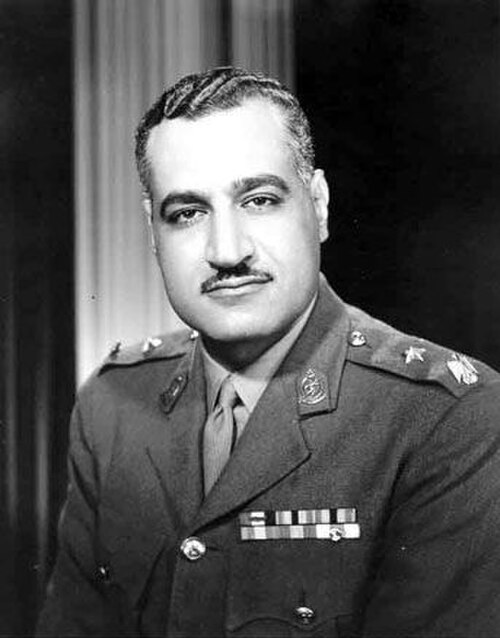
Portrait of Gamal Abdel Nasser

Photo: Wikimedia Commons

8Documented controversies
10Sources
0Formal charge · all time
0Conviction

I. Documented controversies

01

1952-1970

Authoritarian consolidation: exclusion of parties, extensive security apparatus and thousands of political prisoners

No legal proceedings

Following the Free Officers' revolution, the political system rapidly closed down: former parties were neutralised, associations and professional bodies brought under control, the security apparatus strengthened and opponents imprisoned. The collective power of the RCC gradually gave way to Nasser's personal dominance and a single-party system.

State of the evidence
Documented
Legal status — source text
Not applicable
Attribution
Direct responsibility

Sources · 1

  1. [1]
    The New YorkerMan of GamaliyaMediaHigh reliability

Last verified: 19 August 2026

Add to this entry

02

1960-1970

Nationalisation of the press and control of information

No legal proceedings

In 1960, the regime nationalised the private press and placed most major media outlets within state-controlled structures, strengthening the authorities' ability to shape information and restrict pluralism.

State of the evidence
Documented
Legal status — source text
Not applicable
Attribution
Political responsibility

Sources · 2

  1. [1]
    Open Book PublishersArab Media Systems — EgyptresearchHigh reliability
  2. [2]
    The New YorkerMan of GamaliyaMediaHigh reliability

Last verified: 19 August 2026

Add to this entry

03

1962-1967

Intervention in Yemen: costly war retrospectively described as Egypt's "Vietnam"

No legal proceedings

Nasser deployed tens of thousands of soldiers to North Yemen to support the republican revolution. The war exacted a very heavy toll in lives and resources and exhausted the military and economy.

State of the evidence
Documented
Legal status — source text
Not applicable
Attribution
Political responsibility

Last verified: 19 August 2026

Add to this entry

04

1967

Six-Day War: catastrophic defeat, loss of Sinai and resignation announced then withdrawn

No legal proceedings

The 1967 war destroyed much of Egypt's air force and army within days and resulted in the loss of Sinai. Nasser announced his resignation before withdrawing it following demonstrations of support.

State of the evidence
Documented
Legal status — source text
Not applicable
Attribution
Political responsibility

Sources · 1

  1. [1]
    U.S. Office of the HistorianHistorical Documents - Nasser resignation after 1967 warGovernment sourceHigh reliability

Last verified: 19 August 2026

Add to this entry

05

1965-1966

Sayyid Qutb: new revolutionary trial and execution in 1966

Conviction — against Sayyid Qutb

Protagonist not prosecuted — these proceedings are not counted in their formal charges or convictions.

Released in 1964 and rearrested in 1965, Muslim Brotherhood ideologue Sayyid Qutb was accused of plotting against the regime, sentenced to death and hanged in August 1966. Testimonies describe a revolutionary trial lacking ordinary defence safeguards.

Attribution
Political responsibility
Person targeted by the proceedings
Sayyid Qutb
Role of the person profiled
Protagonist not prosecuted

Sources · 1

  1. [1]
    The New YorkerThe Man Behind Bin LadenMediaHigh reliability

Last verified: 19 August 2026

Add to this entry

06

1954-années 1960

Repression of the Muslim Brotherhood after 1954: mass arrests, torture and executions

No legal proceedings

After the assassination attempt against Nasser in October 1954, the regime arrested more than a thousand people linked or allegedly linked to the Muslim Brotherhood, conducted exceptional trials and carried out executions. Historical accounts and academic research also document torture in detention.

State of the evidence
Documented
Legal status — source text
Not applicable
Attribution
Direct responsibility

Sources · 3

  1. [1]
    The New YorkerThe Man Behind Bin LadenMediaHigh reliability
  2. [2]
  3. [3]
    The New YorkerMan of GamaliyaMediaHigh reliability

Last verified: 19 August 2026

Add to this entry

07

années 1950-1960

Nationalisations and state socialism: economic transformation and marginalisation of the private sector

No legal proceedings

Successive waves of nationalisation transferred banks, industries and major companies into public ownership, accelerating industrialisation but also prompting capital and entrepreneurs to leave the country and strengthening the state bureaucracy.

State of the evidence
Documented
Legal status — source text
Not applicable
Attribution
Political responsibility

Sources · 2

  1. [1]
    The Cairo ReviewSixty Years of Egyptian Politics: What Has Changed?researchHigh reliability
  2. [2]

Last verified: 19 August 2026

Add to this entry

08

1956

Nationalisation of the Suez Canal: sovereign decision triggering an international war

No legal proceedings

Nasser's nationalisation of the Suez Canal Company prompted the invasion of Egypt by Israel, France and the United Kingdom and one of the most serious international crises of the post-war period.

State of the evidence
Documented
Legal status — source text
Not applicable
Attribution
Directly implicated

Sources · 1

  1. [1]
    U.S. Office of the HistorianThe Suez Crisis, 1956Government sourceHigh reliability

Last verified: 19 August 2026

Add to this entry

II. Constellation of documented links

No documented link with another published profile for now.

Two profiles are linked when a documented controversy of one names the other. The link points to that controversy and its sources; it does not indicate a personal relationship.

III. Has something changed?

A new court decision, a missing source, a mistake? Tell us what should be updated: every request is read by the editorial team.

iPhone and iPad

Install Controversia

  1. Tap Share
  2. then Add to Home Screen

Tap Share, then Add to Home Screen.