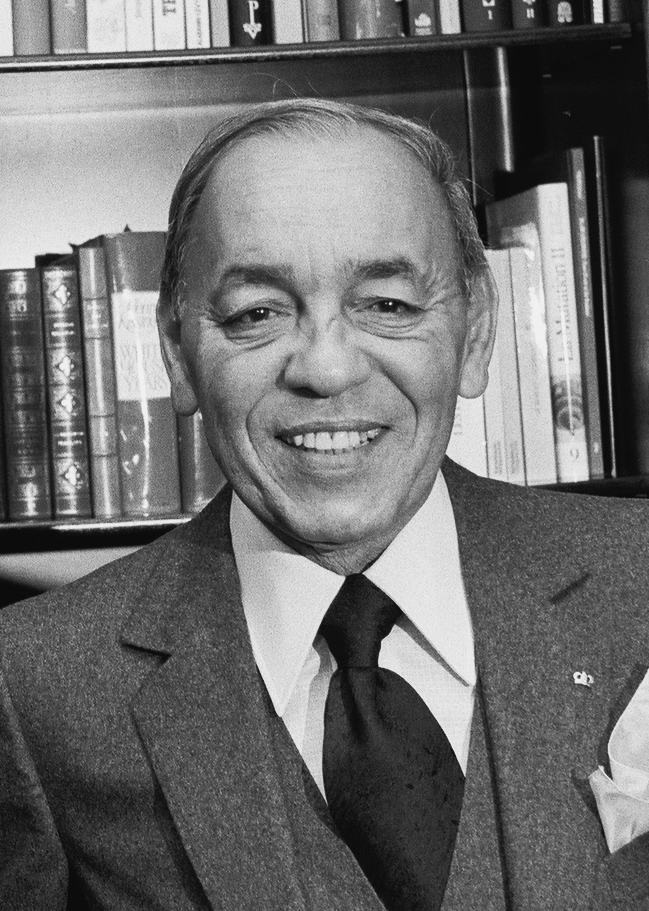
Portrait of Hassan II

Photo: Christian Lambiotte · CC BY 4.0 · Wikimedia Commons

Born in Morocco · Nationality Moroccan — Monarchy / politics / history

Hassan II

Documented profile covering 17 controversies, including “Disappearance of Mehdi Ben Barka and responsibility of the Moroccan state apparatus” and “Years of Lead: enforced disappearances, arbitrary detention and torture”.

Are you concerned? Right of reply

Profile No. 0628 · Updated on 12 October 2026

Portrait of Hassan II

Photo: Christian Lambiotte · CC BY 4.0 · Wikimedia Commons

17Documented controversies
18Sources
0Formal charge · all time
0Conviction

I. Documented controversies

01

1961-1999

Years of Lead: enforced disappearances, arbitrary detention and torture

No legal proceedings

The Equity and Reconciliation Commission and human rights research documented enforced disappearances, arbitrary detentions and other serious violations during the period encompassing Hassan II's reign.

State of the evidence
Documented
Attribution
Political responsibility

Sources · 3

  1. [1]
  2. [2]
    Human Rights WatchMorocco, the Kingdom of Unfinished ReformsHigh reliability
  3. [3]
    Conseil National des Droits de l’HommeL’approche adoptée par la commission de mise en œuvreOfficial documentHigh reliability

Last verified: 18 August 2026

Add to this entry

02

1988-1993

Hassan II Mosque: public subscription transformed into a coercive levy

No legal proceedings

Funding for the Hassan II Mosque in Casablanca was presented as a public subscription. However, a 1988 Le Monde investigation documented strong administrative pressure: employees contributing the equivalent of one month's salary, farmers facing threats and other groups compelled to contribute, leading the newspaper and the opposition to describe it as a quasi-tax levy or a circumvention of the law.

State of the evidence
Documented
Attribution
Directly implicated

Last verified: 18 August 2026

Add to this entry

03

1970s-1991

Tazmamart: secret prison and prolonged detention of military personnel

No legal proceedings

Military personnel linked to attempted coups were held for many years in the secret Tazmamart prison under extreme conditions.

State of the evidence
Documented
Attribution
Political responsibility

Sources · 2

  1. [1]
    Le MondeLe système Hassan IIMediaHigh reliability
  2. [2]

Last verified: 18 August 2026

Add to this entry

04

1972-1991

Eighteen-year detention of General Oufkir's family

No legal proceedings

Following the attempted coup attributed to General Oufkir, members of his family were detained for more than eighteen years without ordinary individual responsibility being established.

State of the evidence
Documented
Attribution
Political responsibility

Sources · 2

  1. [1]
  2. [2]
    Le MondeLe système Hassan IIMediaHigh reliability

Last verified: 18 August 2026

Add to this entry

05

1970s-1990s

Repression and disappearances linked to Western Sahara

No legal proceedings

The violations examined by the truth commission included disappearances and arbitrary detentions involving Sahrawis during Hassan II's reign.

State of the evidence
Documented
Attribution
Political responsibility

Sources · 2

  1. [1]
  2. [2]
    Conseil National des Droits de l’HommeL’approche adoptée par la commission de mise en œuvreOfficial documentHigh reliability

Last verified: 18 August 2026

Add to this entry

06

1990

Repression of 1990 riots: disproportionate use of force and 112 deaths recognised by the IER

No legal proceedings

The Equity and Reconciliation Commission established that 112 people died during the 1990 events in Fez as a result of disproportionate use of force by the authorities. This episode is distinct from the broader systemic repression of the "Years of Lead".

State of the evidence
Documented
Attribution
Political responsibility

Sources · 1

  1. [1]
    Conseil National des Droits de l’HommeL’approche adoptée par la commission de mise en œuvreOfficial documentHigh reliability

Last verified: 18 August 2026

Add to this entry

07

1960s-1990s

Patronage system, favouritism and economic concentration around the monarchy

No legal proceedings

Diplomatic and academic analyses describe Hassan II's regime as relying heavily on personal relationships, patronage and co-option, with an elite closely connected to the palace and recurring allegations of corruption and favouritism at senior levels of government. Royal economic control, particularly involving ONA and land, fuelled criticism of the intertwining of political power and private economic interests.

State of the evidence
Documented
Attribution
Political responsibility

Sources · 2

  1. [1]
    U.S. Department of State, Office of the HistorianNational Intelligence Estimate 61–72ArchiveHigh reliability
  2. [2]
    U.S. Department of State, Office of the HistorianHistorical Documents — Morocco political situation and corruptionArchiveHigh reliability

Last verified: 18 August 2026

Add to this entry

08

1984

Repression of 1984 riots: disproportionate use of force and 49 deaths recognised by the IER

No legal proceedings

The Equity and Reconciliation Commission established that 49 people died during the 1984 events in several cities as a result of disproportionate use of force by the authorities. This episode is distinct from the broader systemic repression of the "Years of Lead".

State of the evidence
Documented
Attribution
Political responsibility

Sources · 1

  1. [1]
    Conseil National des Droits de l’HommeL’approche adoptée par la commission de mise en œuvreOfficial documentHigh reliability

Last verified: 18 August 2026

Add to this entry

09

1981

Repression of 1981 riots: disproportionate use of force and 114 deaths recognised by the IER

No legal proceedings

The Equity and Reconciliation Commission established that 114 people died during the 1981 events in Casablanca as a result of disproportionate use of force by the authorities. This episode is distinct from the broader systemic repression of the "Years of Lead".

State of the evidence
Documented
Attribution
Political responsibility

Sources · 1

  1. [1]
    Conseil National des Droits de l’HommeL’approche adoptée par la commission de mise en œuvreOfficial documentHigh reliability

Last verified: 18 August 2026

Add to this entry

10

1975-1979

Western Sahara: Green March and annexation following ICJ opinion on self-determination

No legal proceedings

In 1975, Hassan II organised the Green March, mobilising hundreds of thousands of Moroccans towards Western Sahara as Spain withdrew. The operation was launched following an International Court of Justice advisory opinion recognising certain historical ties with Morocco but not finding territorial sovereignty that would override the Sahrawi people's right to self-determination. The territory was subsequently administered mainly by Morocco, initiating a prolonged conflict with the Polisario Front.

State of the evidence
Documented
Attribution
Political responsibility

Sources · 2

  1. [1]
    International Court of JusticeWestern Sahara — Advisory OpinionCourt recordHigh reliability
  2. [2]
    International Committee of the Red CrossWestern Sahara — ICRC CasebookHigh reliability

Last verified: 18 August 2026

Add to this entry

11

1972

General Oufkir's death in 1972: official suicide account persistently disputed

No legal proceedings

Following the failed air force coup of August 1972, General Mohamed Oufkir, Defence Minister and former powerful regime figure, was found dead. The authorities announced a suicide, but reports of multiple bullet wounds and subsequent testimonies from his family fuelled the hypothesis of an execution at the palace for decades.

State of the evidence
Disputed
Attribution
Personally implicated

Last verified: 18 August 2026

Add to this entry

12

1971

After the 1971 Skhirat coup: swift executions of senior officers

No legal proceedings

Following the failed Skhirat coup of 10 July 1971, several senior officers suspected of participating in the plot were executed very quickly. US diplomatic archives describe a decimation of the military high command, with generals killed or executed, while historical accounts report the execution of officers by firing squad a few days after the coup.

State of the evidence
Documented

Sources · 2

  1. [1]
    U.S. Department of State, Office of the HistorianHistorical Documents — Morocco after the July 1971 coup attemptArchiveHigh reliability
  2. [2]
    Association for Diplomatic Studies and TrainingThe Birthday Party Coup Attempt on Morocco's King Hassan IISecondary sourceMedium reliability

Last verified: 18 August 2026

Add to this entry

13

1965-1970

1965 state of exception: suspension of parliament and direct concentration of royal power

No legal proceedings

Following the bloody Casablanca riots of 1965, Hassan II prorogued parliament and introduced a state of exception that effectively suspended institutional political activity for five years. Contemporary US diplomatic documents subsequently described the 1970 Constitution as confirming royal supremacy over the entire government.

State of the evidence
Documented
Legal status — source text
Not applicable
Attribution
Political responsibility

Sources · 1

  1. [1]
    U.S. Department of State, Office of the HistorianNational Intelligence Estimate 61–72ArchiveHigh reliability

Last verified: 18 August 2026

Add to this entry

14

1965-1967

1965 Arab summit: recordings passed to Israeli intelligence before the Six-Day War

No legal proceedings

Former Israeli officials revealed that Morocco had enabled Mossad and Shin Bet to obtain secret discussions from the 1965 Arab summit in Casablanca, which focused partly on military capabilities against Israel. The recordings reportedly helped Israeli intelligence assess the weakness of Arab armies before the 1967 war.

State of the evidence
Documented
Legal status — source text
Not applicable

Sources · 2

  1. [1]
  2. [2]
    YnetThe ghosts of Saint-Germain forestMediaMedium reliability

Last verified: 18 August 2026

Add to this entry

15

1965

Disappearance of Mehdi Ben Barka and responsibility of the Moroccan state apparatus

Allegations

Opposition figure Mehdi Ben Barka disappeared in Paris in 1965. Moroccan intelligence officials were implicated in proceedings and investigations; the case remains emblematic of the Years of Lead.

State of the evidence
Disputed

Sources · 2

  1. [1]
    Le MondeLe système Hassan IIMediaHigh reliability
  2. [2]
    Human Rights WatchMorocco, the Kingdom of Unfinished ReformsHigh reliability

Last verified: 18 August 2026

Add to this entry

16

1965

Repression of 1965 riots: disproportionate use of force and 50 deaths recognised by the IER

No legal proceedings

The Equity and Reconciliation Commission established that 50 people died during the 1965 events in Casablanca as a result of disproportionate use of force by the authorities. This episode is distinct from the broader systemic repression of the "Years of Lead".

State of the evidence
Documented
Attribution
Political responsibility

Sources · 1

  1. [1]
    Conseil National des Droits de l’HommeL’approche adoptée par la commission de mise en œuvreOfficial documentHigh reliability

Last verified: 18 August 2026

Add to this entry

17

1958-1959

1958-1959 Rif uprising: repression commanded by Crown Prince Hassan

No legal proceedings

Before ascending the throne, Crown Prince Moulay Hassan played a command role in the military repression of the 1958-1959 Rif uprising. Academic studies describe the intervention of the Royal Armed Forces under his command and identify the episode as a major precedent in his relationship with the Rif.

State of the evidence
Documented
Attribution
Directly implicated

Sources · 2

  1. [1]
    Cambridge University PressState-building and the politics of national identity in MoroccoAcademic publicationHigh reliability
  2. [2]
    Cambridge University PressAre Arab Monarchical Militaries Different?Academic publicationHigh reliability

Last verified: 18 August 2026

Add to this entry

II. Constellation of documented links

  • Linked profile (portrait or initials) — click to open it
  • Line width: number of documented references
  • Hover over or tap a line: controversies and sources

Two profiles are linked when a documented controversy of one names the other. The link points to that controversy and its sources; it does not indicate a personal relationship.

List of documented links (1)
  1. Driss Basri1 documented reference

III. Has something changed?

A new court decision, a missing source, a mistake? Tell us what should be updated: every request is read by the editorial team.

iPhone and iPad

Install Controversia

  1. Tap Share
  2. then Add to Home Screen

Tap Share, then Add to Home Screen.