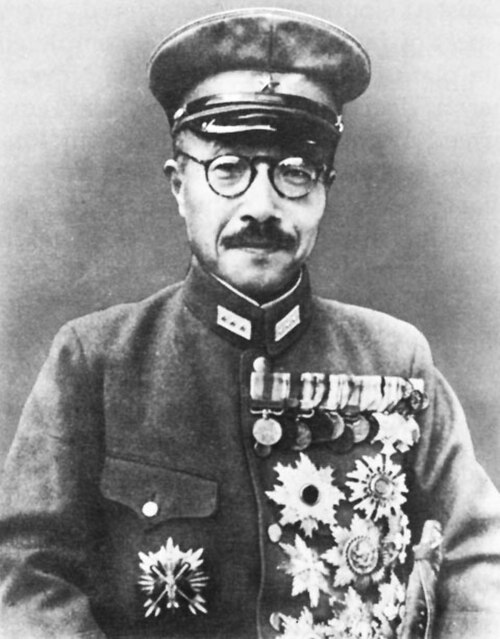
Portrait of Hideki Tojo

Photo: Public domain · Wikimedia Commons

Born in Japan · Nationality Japanese — Politics / military / Second World War / repression / war crimes / international justice

Hideki Tojo

Documented profile covering 11 controversies, including “1935–1937: Command of Kwantung Army military police and rise within Japanese apparatus in Manchuria” and “1937–1938: Kwantung Army chief of staff during expansion of war in China”.

Are you concerned? Right of reply

Profile No. 1890 · Updated on 12 October 2026

Portrait of Hideki Tojo

Photo: Public domain · Wikimedia Commons

11Documented controversies+ 3 background events
6Sources
1Formal charge · all time1 followed by a conviction
1Conviction

I. Documented controversies

Case · 8 documented stages

1946–1948: Convicted by Tokyo Tribunal and executed, with major judicial dissents

Conviction
01

3 May 1946–23 December 1948

1946–1948: Convicted by Tokyo Tribunal and executed, with major judicial dissents

Conviction

Tojo was tried alongside Japan's principal leaders by the International Military Tribunal for the Far East, found guilty in connection with the crimes against peace and wartime offences established by the Tribunal, sentenced to death and hanged at Sugamo on 23 December 1948.

State of the evidence
Established by a court
Attribution
Accused

Sources · 3

  1. [1]
    The National WWII MuseumTokyo War Crimes TrialOfficial documentHigh reliability
  2. [2]
    The National WWII MuseumJustice Radhabinod Pal and the Tokyo TribunalArchiveHigh reliability
  3. [3]
    National Diet Library, JapanTOJO Hideki — Portraits of Modern Japanese Historical FiguresSecondary sourceHigh reliability

Last verified: 13 September 2026

Add to this entry

02

11 September 1945

1945: Suicide attempt during arrest by Allied forces

Formally charged

When Allied authorities came to arrest him, Tojo shot himself in the chest. He survived after medical treatment and was subsequently tried.

State of the evidence
Documented
Attribution
Personally implicated

Sources · 2

  1. [1]
    National Diet Library, JapanTOJO Hideki — Portraits of Modern Japanese Historical FiguresSecondary sourceHigh reliability
  2. [2]
    HISTORYTôjô HidekiPressHigh reliability

Last verified: 13 September 2026

Add to this entry

04

1941–1944

1941–1944: Governmental command responsibility for mistreatment and atrocities committed during war

Conviction

The International Military Tribunal for the Far East identified Tojo among the leaders responsible for crimes against peace and responsibilities related to the conduct of the war, during which serious crimes were committed against prisoners of war and civilians.

Attribution
Command responsibility

Sources · 2

  1. [1]
    The National WWII MuseumTokyo War Crimes TrialOfficial documentHigh reliability
  2. [2]
    The National WWII MuseumJustice Radhabinod Pal and the Tokyo TribunalArchiveHigh reliability

Last verified: 13 September 2026

Add to this entry

07

December 1941–1942

1941–1942: Conduct and expansion of Japanese wars of aggression across Asia-Pacific

Conviction

Tojo's government oversaw Japanese expansion in South-East Asia and the Pacific, including rapid conquests in the Philippines, Malaya, Singapore, the Dutch East Indies and elsewhere.

State of the evidence
Documented
Attribution
Political responsibility

Sources · 2

  1. [1]
    HISTORYTôjô HidekiPressHigh reliability
  2. [2]
    The National WWII MuseumTokyo War Crimes TrialOfficial documentHigh reliability

Last verified: 13 September 2026

Add to this entry

08

November–7 December 1941

1941: Government decision to wage war against United States and United Kingdom, including Pearl Harbor attack

Conviction

Under Tojo's cabinet, Japan chose war when negotiations with the United States failed. The attack on Pearl Harbor and simultaneous offensives opened the Pacific War against Western powers.

State of the evidence
Documented
Attribution
Political responsibility

Sources · 2

  1. [1]
    HISTORYTôjô HidekiPressHigh reliability
  2. [2]
    National Diet Library, JapanTOJO Hideki — Portraits of Modern Japanese Historical FiguresSecondary sourceHigh reliability

Last verified: 13 September 2026

Add to this entry

09

July–September 1940

1940: War Minister and supporter of Tripartite Pact with Nazi Germany and fascist Italy

Conviction

Having become War Minister, Tojo advocated military strength and supported Japan's accession to the Tripartite Pact with Germany and Italy.

State of the evidence
Documented
Attribution
Political responsibility

Sources · 2

  1. [1]
    HISTORYTôjô HidekiPressHigh reliability
  2. [2]
    National Diet Library, JapanTOJO Hideki — Portraits of Modern Japanese Historical FiguresSecondary sourceHigh reliability

Last verified: 13 September 2026

Add to this entry

10

1937–May 1938

1937–1938: Kwantung Army chief of staff during expansion of war in China

Conviction

As Kwantung Army chief of staff, Tojo held a senior position while the Sino-Japanese War expanded and Japanese foreign policy became increasingly militarised.

State of the evidence
Documented
Attribution
Command responsibility

Sources · 2

  1. [1]
    National Diet Library, JapanTOJO Hideki — Portraits of Modern Japanese Historical FiguresSecondary sourceHigh reliability
  2. [2]
    HISTORYTôjô HidekiPressHigh reliability

Last verified: 13 September 2026

Add to this entry

11

1935–1937

1935–1937: Command of Kwantung Army military police and rise within Japanese apparatus in Manchuria

Conviction

Tojo commanded the Kwantung Army's military police in Manchuria before becoming the army's chief of staff. This period consolidated his position among officers favouring a hardline imperial policy in China.

State of the evidence
Documented
Attribution
Command responsibility

Sources · 2

  1. [1]
    National Diet Library, JapanTōjō Hideki related documentsArchiveHigh reliability
  2. [2]
    HISTORYTôjô HidekiPressHigh reliability

Last verified: 13 September 2026

Add to this entry

03

1941–1944

1941–1944: Interior Ministry, political control, thought police and restrictions on freedoms

No legal proceedings

Tojo briefly combined his office with the Interior Ministry and then exercised general influence over an already highly repressive wartime state. The thought police and censorship further restricted opportunities for political opposition.

State of the evidence
Documented
Attribution
Direct responsibility

Sources · 2

  1. [1]
    HISTORYTôjô HidekiPressHigh reliability
  2. [2]
    National Diet Library, JapanTOJO Hideki — Portraits of Modern Japanese Historical FiguresSecondary sourceHigh reliability

Last verified: 13 September 2026

Add to this entry

05

February–July 1944

1944: Becomes Army chief of staff while serving as Prime Minister and War Minister

No legal proceedings

In February 1944, Tojo also became Army chief of staff, combining civilian, ministerial and operational command roles to an exceptionally extensive degree.

State of the evidence
Documented
Attribution
Personally implicated

Sources · 2

  1. [1]
    National Diet Library, JapanTOJO Hideki — Portraits of Modern Japanese Historical FiguresSecondary sourceHigh reliability
  2. [2]
    HISTORYTôjô HidekiPressHigh reliability

Last verified: 13 September 2026

Add to this entry

06

18 July 1944

1944: Forced resignation following fall of Saipan and worsening war

No legal proceedings

After the loss of Saipan and deterioration of the military situation, criticism at the highest levels of the state forced the entire Tojo cabinet to resign.

State of the evidence
Documented
Attribution
Political responsibility

Sources · 2

  1. [1]
    National Diet Library, JapanTOJO Hideki — Portraits of Modern Japanese Historical FiguresSecondary sourceHigh reliability
  2. [2]
    HISTORYTôjô HidekiPressHigh reliability

Last verified: 13 September 2026

Add to this entry

II. Documented background

Documented biographical or institutional milestones (elections, appointments, foundings, acquisitions…). These are not controversies and are not counted as such.

  1. 18 October 1941–1944

    October 1941: Appointed Prime Minister and combines key ministerial portfolios

    Tojo became Prime Minister while retaining the War Ministry and initially holding the Interior Ministry. He subsequently accumulated other functions, concentrating an exceptional share of political and military power.

    Sources · 2
    1. National Diet Library, Japan — TOJO Hideki — Portraits of Modern Japanese Historical Figures
    2. HISTORY — Tôjô Hideki
  2. April 1942

    1942: Yokusan election and creation of Parliament largely favourable to Tojo

    The government organised the 1942 election using a candidate endorsement system intended to produce a supportive majority. Japan's National Diet Library describes the result as a Parliament rendered largely nominal and a strengthening of the wartime regime.

    Sources · 1
    1. National Diet Library, Japan — TOJO Hideki — Portraits of Modern Japanese Historical Figures
  3. September–October 1941

    1941: Opposes concessions in negotiations with United States, contributing to fall of Konoe cabinet

    As Konoe sought a diplomatic way out with Washington, Tojo opposed concessions he considered excessive and advocated a harder line. The impasse contributed to Konoe's resignation in October 1941.

    Sources · 2
    1. U.S. Army / U.S. Government Publishing Office — Command Decisions — Japanese decision for war and wartime command
    2. HISTORY — Tôjô Hideki

III. Constellation of documented links

No documented link with another published profile for now.

Two profiles are linked when a documented controversy of one names the other. The link points to that controversy and its sources; it does not indicate a personal relationship.

IV. Has something changed?

A new court decision, a missing source, a mistake? Tell us what should be updated: every request is read by the editorial team.

Support the archive

Controversia checks and updates its profiles independently. Support is optional and has no effect on the content of profiles.

Donate

iPhone and iPad

Install Controversia

  1. Tap Share
  2. then Add to Home Screen

Tap Share, then Add to Home Screen.