Born in Germany · Nationality German — politics / German unification / authoritarianism / religion / socialism / colonialism

Otto von Bismarck

Documented profile covering 10 controversies, including “1862: "Blood and iron" speech during Prussian constitutional crisis” and “1863–1866: Governs without parliamentary budget under "gap theory"”.

Are you concerned? Right of reply

Profile No. 2109 · Updated on 12 October 2026

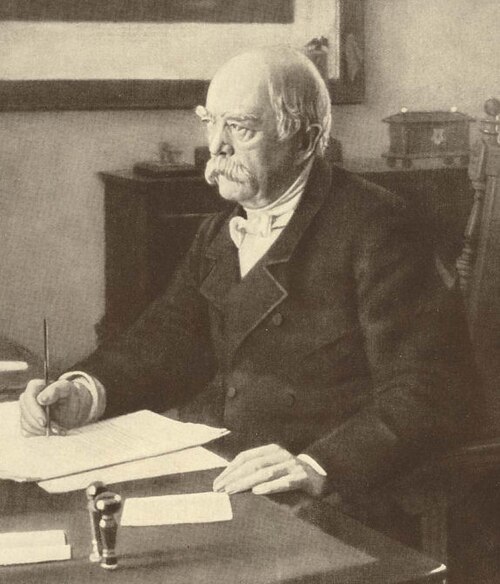
Portrait of Otto von Bismarck

Photo: Wikimedia Commons

10Documented controversies+ 1 background event
16Sources
0Formal charge · all time
0Conviction

I. Documented controversies

01

21 October 1878–30 September 1890

1878–1890: Anti-Socialist Law — bans on associations, meetings and newspapers, mass convictions

Protagonist not prosecuted

Protagonist not prosecuted — these proceedings are not counted in their formal charges or convictions.

The Anti-Socialist Law banned social-democratic, socialist or communist organisations, meetings and publications deemed to threaten public order. It was renewed four times. Historical studies cited by GHDI indicate that approximately 1,500 people were sentenced to more than 800 years of imprisonment in total.

State of the evidence
Documented
Attribution
Political responsibility
Role of the person profiled
Protagonist not prosecuted

Sources · 1

  1. [1]
    German History in Documents and ImagesAnti-Socialist Law (October 21, 1878)Academic publicationVery high reliability

Last verified: 14 September 2026

Add to this entry

02

1886–1890

1886: Germanisation policy and Settlement Commission in Polish provinces

No legal proceedings

Bismarck advocated a tougher policy towards Polish-speaking populations in the Prussian parliament. The Settlement Commission created in 1886 used public funds to encourage land purchases and settlement by German colonists in the eastern provinces, to the detriment of Polish landownership.

State of the evidence
Documented
Attribution
Personally implicated

Sources · 2

  1. [1]
    German History in Documents and ImagesBismarck’s Speech to the Prussian House of Deputies on the “Polish Question” (January 28, 1886)Academic publicationVery high reliability
  2. [2]
    German History in Documents and ImagesGermanization Policy: Speech by Ludwik Jazdzewski (1901)Academic publicationVery high reliability

Last verified: 14 September 2026

Add to this entry

03

1884–1885

1884–1885: Colonial policy reversal — German protectorates and Berlin Conference

No legal proceedings

Having long been reluctant about colonial expansion, Bismarck accepted several African protectorates from 1884 and convened the Berlin Conference on Africa. In February 1885, an imperial letter of protection co-signed by Bismarck placed territories in East Africa under German sovereignty and granted a colonial company jurisdictional powers over local populations.

State of the evidence
Documented
Attribution
Political responsibility

Sources · 2

  1. [1]
    U.S. Office of the HistorianGerman protection for territories in East Africa, February 27, 1885ArchiveVery high reliability
  2. [2]
    Cambridge University PressCareer Beginnings, Eastern InterestsAcademic publicationVery high reliability

Last verified: 14 September 2026

Add to this entry

04

May–October 1878

1878: Exploits assassination attempts against Wilhelm I and dissolves Reichstag to secure anti-socialist majority

No legal proceedings

Following two assassination attempts against Wilhelm I, Bismarck politically accused the Social Democrats and called new elections after an initial anti-socialist bill failed. Historical sources indicate that he knew attributing the attacks to the SPD was unfounded but exploited the climate of fear to secure election of a more conservative Reichstag.

State of the evidence
Documented
Attribution
Political responsibility

Sources · 2

  1. [1]
    German History in Documents and ImagesAnti-Socialist Law (October 21, 1878)Academic publicationVery high reliability
  2. [2]
    German History in Documents and Images“Reichstag Dissolution” (July 7, 1878)Academic publicationVery high reliability

Last verified: 14 September 2026

Add to this entry

05

March 1872–May 1875

1872–1875: Intensification of Kulturkampf — school control, May Laws and restrictions on Catholic orders

No legal proceedings

Under Bismarck and minister Adalbert Falk, Prussia transferred school inspection to the state, then adopted the May Laws of 1873 and further measures imposing stricter supervision of clergy training and appointments. In 1875, additional restrictions targeted Catholic orders and congregations.

State of the evidence
Documented
Attribution
Shared responsibility

Sources · 3

  1. [1]
    German History in Documents and ImagesSchool Inspection Law (March 11, 1872)Academic publicationVery high reliability
  2. [2]
    German History in Documents and ImagesIntroduction — Bismarckian GermanyAcademic publicationVery high reliability
  3. [3]
    German History in Documents and ImagesKulturkampf Legislation (May 31, 1875)Academic publicationVery high reliability

Last verified: 14 September 2026

Add to this entry

06

4 July 1872

1872: Anti-Jesuit law — order banned and members subject to expulsion

Civil / administrative proceedings

The law of 4 July 1872 excluded Jesuits and related congregations from imperial territory, required the dissolution of their establishments and authorised the expulsion of foreign members or residence restrictions on German nationals.

State of the evidence
Documented
Attribution
Political responsibility

Sources · 1

  1. [1]
    German History in Documents and ImagesAnti-Jesuit Law (July 4, 1872)Academic publicationVery high reliability

Last verified: 14 September 2026

Add to this entry

07

10 December 1871

1871: "Pulpit Law" — criminalisation of certain political statements by clergy

No legal proceedings

At the beginning of the Kulturkampf, the Reich adopted the "Pulpit Law", allowing clergy members to be imprisoned for publicly discussing state affairs in a manner considered likely to disturb public peace. The measure constituted a direct attack on the Catholic clergy's political autonomy.

State of the evidence
Documented
Attribution
Political responsibility

Sources · 1

  1. [1]
    German History in Documents and Images“Pulpit Law” (December 10, 1871)Academic publicationVery high reliability

Last verified: 14 September 2026

Add to this entry

08

13–19 July 1870

1870: Deliberately edits Ems Dispatch to provoke France and create a casus belli

No legal proceedings

Bismarck shortened and reformulated the account of a meeting between Wilhelm I and French ambassador Benedetti before releasing it to the press. Authoritative historical sources conclude that he intended to provoke a French reaction and make Prussia appear the victim of aggression.

State of the evidence
Documented
Attribution
Directly implicated

Sources · 1

  1. [1]
    German History in Documents and ImagesOriginal and Edited Versions of the Ems Dispatch (July 13, 1870)Academic publicationVery high reliability

Last verified: 14 September 2026

Add to this entry

09

1863–September 1866

1863–1866: Governs without parliamentary budget under "gap theory"

No legal proceedings

Unable to reach agreement with the House of Representatives on military reform, Bismarck governed for several years without an approved parliamentary budget, invoking a constitutional "gap" to allow the Crown and government to continue acting.

State of the evidence
Documented
Attribution
Political responsibility

Sources · 1

  1. [1]
    Otto-von-Bismarck-StiftungBismarck as Prime Minister from 1862 to 1871Secondary sourceVery high reliability

Last verified: 14 September 2026

Add to this entry

10

30 September 1862

1862: "Blood and iron" speech during Prussian constitutional crisis

No legal proceedings

Before the budget committee of the Prussian Landtag, Bismarck declared that the great questions of the age would not be decided by speeches and majority votes, but by "iron and blood". The phrase became emblematic of his conception of power and immediately fuelled accusations of militarism and authoritarianism.

State of the evidence
Documented
Attribution
Personally implicated

Sources · 1

  1. [1]
    Otto-von-Bismarck-StiftungSpeech to the Budget Commission, September 30, 1862Primary sourceVery high reliability

Last verified: 14 September 2026

Add to this entry

II. Documented background

Documented biographical or institutional milestones (elections, appointments, foundings, acquisitions…). These are not controversies and are not counted as such.

  1. March 1885–1886

    1885–1886: Expulsion of approximately 32,000 foreign Poles and Jews from Prussia

    The Prussian government ordered the expulsion of approximately 32,000 Polish and Jewish nationals of Russia or Austria-Hungary living in the eastern provinces. According to the studies cited, approximately one third of those expelled were Jewish. The measure formed part of a policy seeking to limit the Polish presence and strengthen the German character of eastern Prussia.

    Sources · 2
    1. Cambridge University Press — Career Beginnings, Eastern Interests
    2. Cambridge University Press — German Empire (Berlin) — diplomatic reports on expulsions of Poles

III. Constellation of documented links

No documented link with another published profile for now.

Two profiles are linked when a documented controversy of one names the other. The link points to that controversy and its sources; it does not indicate a personal relationship.

IV. Has something changed?

A new court decision, a missing source, a mistake? Tell us what should be updated: every request is read by the editorial team.

Support the archive

Controversia checks and updates its profiles independently. Support is optional and has no effect on the content of profiles.

Donate

iPhone and iPad

Install Controversia

  1. Tap Share
  2. then Add to Home Screen

Tap Share, then Add to Home Screen.