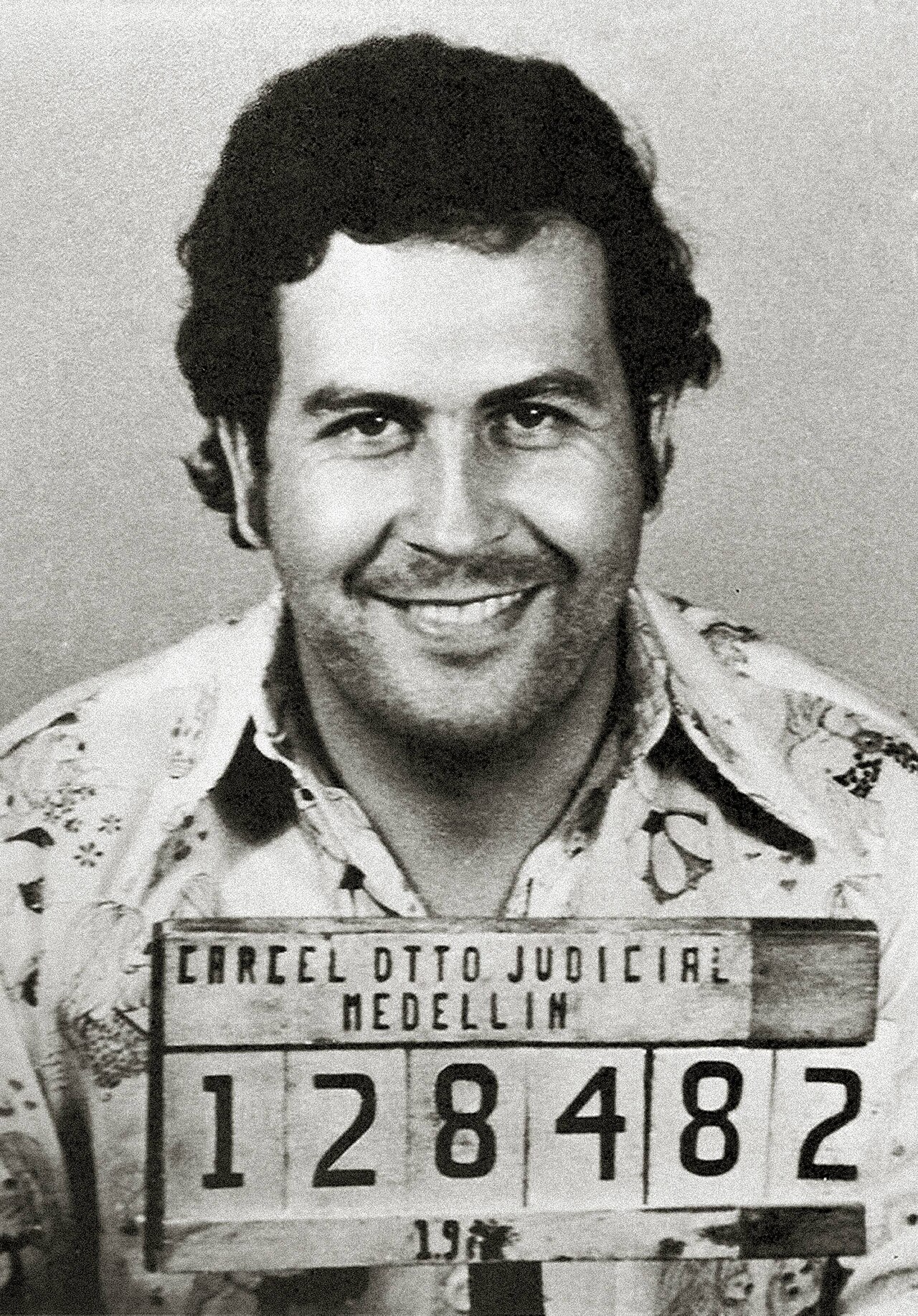
Portrait of Pablo Escobar

Photo: Colombian National Police · Public domain

Born in Colombia · Nationality Colombian — Organised crime / drug trafficking / terrorism / politics / history

Pablo Escobar

Documented profile covering 14 controversies, including “1970s–1993: Leadership of Medellín cartel and large-scale international cocaine trafficking” and “1982–1984: Entry into politics followed by removal after public exposure of criminal background”.

Are you concerned? Right of reply

Profile No. 1478 · Updated on 12 October 2026

Portrait of Pablo Escobar

Photo: Colombian National Police · Public domain

14Documented controversies
23Sources
1Formal charge · all time1 pending
0Conviction

I. Documented controversies

01

1970s-1993

1970s–1993: Leadership of Medellín cartel and large-scale international cocaine trafficking

Investigation

Pablo Escobar was one of the principal leaders of the Medellín cartel, an organisation which built a transnational network for producing, transporting and distributing cocaine to the United States and other markets.

State of the evidence
Documented
Attribution
Direct responsibility

Sources · 2

  1. [1]
    U.S. Drug Enforcement AdministrationDEA History 1975-1980Official documentVery high reliability
  2. [2]
    U.S. Drug Enforcement AdministrationCourt Records Reveal Medellin Cartel Kingpin's Drug EmpireGovernment sourceVery high reliability

Last verified: 12 September 2026

Add to this entry

02

1991-1992

1991: Negotiated surrender and privileged detention in La Catedral prison

Formally charged

After adoption of a constitutional framework prohibiting extradition of Colombians, Escobar surrenders in June 1991. He is held at La Catedral prison, built with highly favourable conditions and soon criticised as a facility from which he retained substantial freedom.

State of the evidence
Documented
Attribution
Personally implicated

Sources · 3

  1. [1]
    Los Angeles TimesColombia Drug Lord Escobar SurrendersMediaHigh reliability
  2. [2]
    Comisión de la Verdad de ColombiaLa ConstituyenteOfficial documentVery high reliability
  3. [3]
    Centro Nacional de Memoria HistóricaLínea de tiempo del conflicto armado en ColombiaOfficial documentVery high reliability

Last verified: 12 September 2026

Add to this entry

03

1992-07

1992: Murders of Galeano and Moncada at La Catedral, followed by escape during attempted transfer

No legal proceedings

Following an internal dispute over money, traffickers Fernando Galeano and Gerardo 'Kiko' Moncada are killed at La Catedral along with several other men. When the government attempts to transfer Escobar to a military facility, he and several associates escape.

State of the evidence
Documented
Attribution
Direct responsibility

Sources · 3

  1. [1]
    El PaísEscobar se fuga de su prisiónMediaHigh reliability
  2. [2]
    El TiempoCITA EN EL PATIBULOMediaHigh reliability
  3. [3]
    Centro Nacional de Memoria HistóricaMedellín: memorias de una guerra urbanaOfficial documentVery high reliability

Last verified: 12 September 2026

Add to this entry

04

1986-1991

1986–1991: 'Extraditables' campaign and narco-terrorism to prevent extradition

No legal proceedings

Under the slogan 'We prefer a grave in Colombia to a prison in the United States', the 'Extraditables', dominated by the Medellín cartel, wage a campaign of bombings, murders, threats and kidnappings designed to force the Colombian state to abandon extradition.

State of the evidence
Documented
Attribution
Direct responsibility

Sources · 2

  1. [1]
    Centro Nacional de Memoria HistóricaLínea de tiempo del conflicto armado en ColombiaOfficial documentVery high reliability
  2. [2]
    Corte Constitucional de ColombiaSentencia SU257/21Court decisionVery high reliability

Last verified: 12 September 2026

Add to this entry

05

1989-1991

1989–1991: Bounties for killing police officers and murder campaign in Medellín

No legal proceedings

During its war against the state, the Medellín cartel pays killers to murder police officers in the city. The Truth Commission describes a campaign which causes the deaths of hundreds of law enforcement officers in Medellín around 1989–1990.

State of the evidence
Documented
Attribution
Direct responsibility

Sources · 1

  1. [1]
    Comisión de la Verdad de ColombiaLa guerra suciaOfficial documentVery high reliability

Last verified: 12 September 2026

Add to this entry

06

1990-1991

1990–1991: Wave of kidnappings of journalists and public figures to influence extradition policy

No legal proceedings

The Extraditables kidnap several journalists and public figures, including Diana Turbay, Francisco Santos and Maruja Pachón, to pressure the government and public opinion over extradition. Diana Turbay dies during a rescue operation.

State of the evidence
Documented
Attribution
Direct responsibility

Sources · 2

  1. [1]
  2. [2]
    El EspectadorViolencia narcoterrorista entre dos gobiernosMediaHigh reliability

Last verified: 12 September 2026

Add to this entry

07

1989-08-18

1989: Assassination of presidential candidate Luis Carlos Galán

No legal proceedings

Liberal candidate Luis Carlos Galán, the favourite for the presidential election and an advocate of extraditing drug traffickers, is assassinated during a rally in Soacha. Colombian judicial decisions describe a criminal plan involving the Medellín cartel and attribute the order to Pablo Escobar.

State of the evidence
Documented
Attribution
Directly implicated

Sources · 2

  1. [1]
    Corte Constitucional de ColombiaSentencia SU257/21Court decisionVery high reliability
  2. [2]
    Corte Suprema de Justicia de ColombiaSP16905-2016Court decisionVery high reliability

Last verified: 12 September 2026

Add to this entry

08

1989-09-02

1989: Bomb attack on El Espectador headquarters

No legal proceedings

A powerful bomb explodes outside El Espectador's headquarters in Bogotá, destroying much of the building and injuring employees and nearby residents. The attack forms part of the cartel's campaign against the newspaper after Guillermo Cano's assassination.

State of the evidence
Documented
Attribution
Directly implicated

Sources · 2

  1. [1]
    El EspectadorEl periodismo en la mira del terrorismoMediaHigh reliability
  2. [2]

Last verified: 12 September 2026

Add to this entry

09

1989-11-27

1989: Destruction of Avianca Flight 203 by bomb

No legal proceedings

Avianca Flight 203 explodes shortly after taking off from Bogotá, killing all 107 people on board and several people on the ground. US authorities treat the bombing as a Medellín cartel operation ordered by Escobar during his campaign against the Colombian state.

State of the evidence
Documented
Attribution
Directly implicated

Sources · 2

  1. [1]
    U.S. Department of JusticeUnited States Attorneys' Bulletin — Avianca Flight 203 prosecutionOfficial documentVery high reliability
  2. [2]
    U.S. Department of JusticeDepartment of Justice Annual Report — Chapter 1Government sourceVery high reliability

Last verified: 12 September 2026

Add to this entry

10

1989-12-06

1989: Truck bomb attack on DAS headquarters in Bogotá

No legal proceedings

A truck bomb explodes outside the headquarters of the Administrative Department of Security (DAS) in Bogotá, killing dozens, injuring hundreds and causing extensive damage. The principal target is DAS director Miguel Maza Márquez, who survives.

State of the evidence
Documented
Attribution
Direct responsibility

Sources · 2

  1. [1]
  2. [2]
    Centro Nacional de Memoria HistóricaLínea de tiempo del conflicto armado en ColombiaOfficial documentVery high reliability

Last verified: 12 September 2026

Add to this entry

11

1986-12-17

1986: Murder of El Espectador director Guillermo Cano

No legal proceedings

Guillermo Cano Isaza, director of the newspaper El Espectador and consistent critic of drug trafficking, is murdered in Bogotá. Investigations and judicial decisions attribute the crime to the Medellín cartel's organisation and identify Escobar as its instigator.

State of the evidence
Documented
Attribution
Directly implicated

Last verified: 12 September 2026

Add to this entry

12

1984-1985

1985: Cartel's financial links to M-19 around Palace of Justice siege — precise responsibility disputed

No legal proceedings

Official reports on the Palace of Justice siege describe contacts between M-19 leaders and Pablo Escobar or the Medellín cartel, as well as money transfers and joint operations in the period preceding the assault. These elements support the hypothesis of financing linked to the objective of destroying extradition files.

State of the evidence
Disputed

Sources · 2

  1. [1]
    Comisión de la Verdad del Palacio de Justicia / CNMHInforme Final de la Comisión de la Verdad sobre los hechos del Palacio de JusticiaOfficial documentVery high reliability
  2. [2]
    Corte Constitucional de ColombiaSentencia T-364/15Court decisionVery high reliability

Last verified: 12 September 2026

Add to this entry

13

1982-1984

1982–1984: Entry into politics followed by removal after public exposure of criminal background

No legal proceedings

In 1982, Escobar obtains a seat as an alternate member of the House of Representatives through the Alternativa Liberal movement, seeking to convert his wealth and local influence into political power. Justice Minister Rodrigo Lara Bonilla publicly exposes his links to drug trafficking.

State of the evidence
Documented
Attribution
Personally implicated

Sources · 2

  1. [1]
    Centro Nacional de Memoria HistóricaLínea de tiempo del conflicto armado en ColombiaOfficial documentVery high reliability
  2. [2]
    Comisión de la Verdad de ColombiaLa guerra suciaOfficial documentVery high reliability

Last verified: 12 September 2026

Add to this entry

14

1984-04-30

1984: Murder of Justice Minister Rodrigo Lara Bonilla attributed to Medellín cartel

No legal proceedings

Rodrigo Lara Bonilla, the Justice Minister who had publicly exposed Escobar and fought drug trafficking networks, is assassinated in Bogotá in April 1984. Institutional and historical accounts attribute the order to the Medellín cartel and Escobar.

State of the evidence
Documented
Attribution
Directly implicated

Sources · 2

  1. [1]
    Comisión de la Verdad de ColombiaEl asesinato de Rodrigo Lara Bonilla y sus implicacionesOfficial documentVery high reliability
  2. [2]

Last verified: 12 September 2026

Add to this entry

II. Constellation of documented links

  • Linked profile (portrait or initials) — click to open it
  • Line width: number of documented references
  • Hover over or tap a line: controversies and sources

Two profiles are linked when a documented controversy of one names the other. The link points to that controversy and its sources; it does not indicate a personal relationship.

List of documented links (4)
  1. José Gonzalo Rodríguez Gacha2 documented references
  2. Diego Murillo Bejarano1 documented reference
  3. Fabio Ochoa Vásquez1 documented reference
  4. Hélmer Herrera1 documented reference

III. Has something changed?

A new court decision, a missing source, a mistake? Tell us what should be updated: every request is read by the editorial team.

iPhone and iPad

Install Controversia

  1. Tap Share
  2. then Add to Home Screen

Tap Share, then Add to Home Screen.