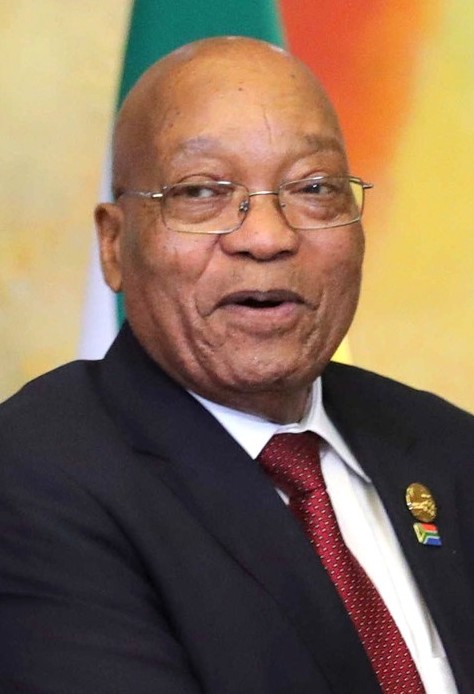
Portrait of Jacob Zuma

Photo: Presidential Press and Information Office / Пресс-служба Президента России · CC BY 4.0 · Wikimedia Commons

Born in South Africa · Nationality South African — Politics / institutions / governance / justice

Jacob Zuma

Documented profile covering 23 controversies, including “Schabir Shaik: judicial finding of a "generally corrupt relationship" with Jacob Zuma” and “Removal from the deputy presidency following Schabir Shaik's conviction”.

Are you concerned? Right of reply

Profile No. 1359 · Updated on 12 October 2026

Portrait of Jacob Zuma

Photo: Presidential Press and Information Office / Пресс-служба Президента России · CC BY 4.0 · Wikimedia Commons

23Documented controversies
32Sources
2Formal charges · all time2 closed without conviction
1Conviction

I. Documented controversies

Case · 3 documented stages

Spy tapes: corruption charges dropped in 2009, then decision to discontinue proceedings ruled irrational and set aside

Case dismissed / dropped
01

2018-03–2026-09

Arms deal case: reinstatement of criminal charges in 2018

Formally charged

Following the judicial annulment of the 2009 decision to drop the case, the NPA announced in March 2018 the reinstatement of charges against Zuma for corruption, racketeering, fraud and money laundering linked to the 1990s arms deal and his relationships with Schabir Shaik and Thales. Zuma appeared in court and pleaded not guilty while pursuing numerous procedural challenges.

State of the evidence
Documented
Attribution
Accused

Sources · 2

  1. [1]
    The Guardian / agenciesSouth Africa reinstates corruption charges against Jacob ZumaPressHigh reliability
  2. [2]
    SAFLII / KwaZulu-Natal High CourtS v Zuma and Another (Leave to Appeal) [2026] ZAKZPHC 54Court recordVery high reliability

Last verified: 11 September 2026

Add to this entry

02

2026-05–2026-09-11

Arms deal case in 2026: High Court orders trial to proceed despite further interlocutory challenges

Formally charged

On 14 May 2026, in criminal proceedings brought by the state against Zuma and Thales, the KwaZulu-Natal High Court dismissed applications for leave to appeal concerning interlocutory challenges and ordered the trial to proceed regardless of further applications of that kind, with trial dates to be set. The judgment recalled the long sequence of challenges which the prosecution characterises as a "Stalingrad" strategy delaying consideration of the merits.

State of the evidence
Documented
Attribution
Accused

Sources · 1

  1. [1]
    SAFLII / KwaZulu-Natal High CourtS v Zuma and Another (Leave to Appeal) [2026] ZAKZPHC 54Court recordVery high reliability

Last verified: 11 September 2026

Add to this entry

14

2009-04–2017-10

Spy tapes: corruption charges dropped in 2009, then decision to discontinue proceedings ruled irrational and set aside

Case dismissed / dropped

In April 2009, shortly before Zuma became president, prosecutors dropped charges of racketeering, corruption, money laundering and fraud linked to the arms deal, citing recordings revealing manipulation of the timing of prosecutions by senior prosecutors. Following years of litigation brought by the DA, the decision to discontinue proceedings was ruled irrational and set aside.

State of the evidence
Documented
Attribution
Directly implicated

Sources · 2

  1. [1]
  2. [2]
    SAFLII / Supreme Court of AppealZuma v Democratic Alliance; Acting NDPP v Democratic Alliance [2017] ZASCA 146Court recordVery high reliability

Last verified: 11 September 2026

Add to this entry

03

2018–2025-12

State-funded legal fees: order to repay 28.96 million rands plus interest

Civil / administrative proceedings

After an earlier decision found the state's payment of Zuma's personal legal fees connected with his prosecutions and related litigation to be invalid, the Presidency and the State Attorney sought enforcement of repayment. On 22 October 2025, the Pretoria High Court ordered Zuma to pay 28 960 774,34 rands, plus interest and costs.

Attribution
Directly implicated

Sources · 2

  1. [1]
  2. [2]
    SAFLII / Gauteng High CourtZuma v Presidency of the Republic of South Africa and Others [2025] ZAGPPHC 1233Court recordVery high reliability

Last verified: 11 September 2026

Add to this entry

Case · 4 documented stages

Disqualification from the National Assembly in 2024 because of contempt sentence

Conviction
04

2024-03–2024-05

Disqualification from the National Assembly in 2024 because of contempt sentence

Conviction

After the uMkhonto weSizwe (MK) party placed Zuma on its list for the 2024 elections, litigation arose concerning the application of Section 47(1)(e) of the Constitution to his 15-month prison sentence for contempt. On 20 May 2024, the Constitutional Court ruled that Zuma had indeed been "convicted of an offence" and sentenced to more than twelve months without the option of a fine, making him ineligible for the National Assembly until the expiry of the constitutional five-year period following completion of the sentence.

Attribution
Directly implicated

Sources · 1

  1. [1]

Last verified: 11 September 2026

Add to this entry

06

2021-09–2023-08

Medical parole granted against board advice, overturned as unlawful, followed by sentence remission in 2023

No legal proceedings

In September 2021, National Commissioner Arthur Fraser granted Zuma medical parole despite the Medical Parole Advisory Board's decision not to recommend it. The courts subsequently set aside that decision as unlawful, and the Supreme Court of Appeal confirmed that Zuma was legally required to return to custody. In August 2023, when he administratively returned to prison, a special remission of sentence granted by the correctional system allowed him to be released the same day.

State of the evidence
Documented

Sources · 2

  1. [1]
  2. [2]
    South African GovernmentCorrectional Services decision on former President Jacob ZumaOfficial documentHigh reliability

Last verified: 11 September 2026

Add to this entry

10

2020–2021-02

Zondo Commission: Constitutional Court order to testify, followed by refusal to comply

Conviction

Following partial appearances and repeated disputes with the Zondo Commission, Zuma refused to continue giving evidence. In January 2021, the Constitutional Court ordered him to appear and answer the Commission's questions. He did not comply with that order and continued his attacks on the Commission's legitimacy and certain judicial figures.

State of the evidence
Documented
Attribution
Personally implicated

Sources · 2

  1. [1]
    SAFLII / Constitutional CourtSecretary of the Judicial Commission v Zuma – contempt judgment contextCourt recordVery high reliability
  2. [2]
    SAFLII / Constitutional CourtSecretary of the Judicial Commission v Zuma – rescission judgmentCourt recordVery high reliability

Last verified: 11 September 2026

Add to this entry

11

2021-06–2021-09

Conviction for contempt of the Constitutional Court and 15-month prison sentence

Conviction

On 29 June 2021, the Constitutional Court found Zuma guilty of the offence of contempt for refusing to comply with the order requiring him to cooperate with the Zondo Commission and sentenced him to 15 months' imprisonment without the option of a fine. His subsequent application for rescission was dismissed.

State of the evidence
Established by a court
Attribution
Personally implicated

Sources · 2

  1. [1]
    SAFLII / Constitutional CourtSecretary of the Judicial Commission of Inquiry v Zuma [2021] ZACC 18Court recordVery high reliability
  2. [2]
    SAFLII / Constitutional CourtElectoral Commission of South Africa v MK Party and Others [2024] ZACC 6Court recordVery high reliability

Last verified: 11 September 2026

Add to this entry

05

2023-12–2024-07

Support for and subsequent leadership of MK, and expulsion from the ANC after the 2024 elections

No legal proceedings

Zuma announced that he would support the new uMkhonto weSizwe (MK) party against the ANC, while initially maintaining that he remained a member of the ANC. Becoming the public face and leader of MK, he contributed to its result of approximately 15% of the vote in 2024, a major factor in the ANC's loss of its absolute majority. The ANC subsequently expelled him for actively working to remove his own party from power.

State of the evidence
Documented
Attribution
Political responsibility

Last verified: 11 September 2026

Add to this entry

07

2022-09–2023-10

Private prosecution of Billy Downer and Karyn Maughan set aside as an abuse of process

Case dismissed / dropped

Zuma instituted a private prosecution against prosecutor Billy Downer and journalist Karyn Maughan, alleging unlawful disclosure of medical information during his corruption trial. A three-judge bench set aside the summonses, prohibited prosecution on the same grounds and ordered Zuma to pay punitive costs; the courts characterised the proceedings as an abuse of process pursued for an ulterior purpose.

State of the evidence
Documented
Attribution
Directly implicated

Sources · 2

  1. [1]
    SAFLII / KwaZulu-Natal High CourtMaughan v Zuma and Others; Downer v Zuma and Another [2023] ZAKZPHC 59Court recordVery high reliability
  2. [2]
    SAFLII / Supreme Court of AppealZuma v Downer and Another [2023] ZASCA 132Court recordVery high reliability

Last verified: 11 September 2026

Add to this entry

08

2022-12–2023-07

Private prosecution of Cyril Ramaphosa set aside as unlawful, unconstitutional and motivated by an ulterior purpose

Case dismissed / dropped

Zuma attempted to prosecute President Cyril Ramaphosa privately, accusing him, among other things, of being an accessory after the fact in the disclosure of his medical certificate by Billy Downer and Karyn Maughan. The High Court set aside the summonses and declared the prosecution unlawful, unconstitutional and invalid.

State of the evidence
Documented
Attribution
Directly implicated

Sources · 1

  1. [1]
    SAFLII / Gauteng High CourtPresident of the Republic of South Africa v Zuma and Others [2023] ZAGPJHC 783Court recordVery high reliability

Last verified: 11 September 2026

Add to this entry

09

2022-01–2022-06

Zondo Commission final report: severe findings on state capture under Zuma's presidency

Investigation

The various parts of the Zondo Commission's final report described systemic state capture during Zuma's presidency and made numerous findings concerning his relationships with the Guptas, his role in certain appointments, his conduct towards state-owned enterprises and his failure to protect institutions from private interests. The report recommended or contemplated investigations and prosecutions in several areas.

State of the evidence
Documented
Attribution
Political responsibility

Sources · 2

  1. [1]
    Commission of Inquiry into Allegations of State CaptureFinal ReportsOfficial documentVery high reliability
  2. [2]
    South African GovernmentJudicial Commission of Inquiry into State Capture Report – documentsOfficial documentVery high reliability

Last verified: 11 September 2026

Add to this entry

12

2016–2018-01

Unsuccessful challenge to the "State of Capture" remedial measure and personal costs order

Civil / administrative proceedings

Zuma sought to have the Public Protector's remedial measure requiring him to establish a judicial commission on state capture set aside. In December 2017, the High Court dismissed his application, upheld the commission mechanism and ordered him personally to pay part of the costs, criticising the unreasonableness of his approach. In January 2018, Zuma eventually established the commission chaired by Judge Raymond Zondo.

State of the evidence
Documented
Attribution
Political responsibility

Sources · 2

  1. [1]
  2. [2]
    South African GovernmentPresident Jacob Zuma on establishment of Commission of Inquiry into State CaptureOfficial documentVery high reliability

Last verified: 11 September 2026

Add to this entry

13

2018-02

Recall by the ANC and forced resignation from the presidency

No legal proceedings

Following a long accumulation of controversies, and after the ANC had elected Cyril Ramaphosa as its leader, the ANC National Executive Committee recalled Zuma in February 2018. The parliamentary caucus was preparing to support a motion of no confidence if he refused to leave. On 14 February, Zuma announced his resignation with immediate effect.

State of the evidence
Documented
Attribution
Political responsibility

Sources · 2

  1. [1]
    South African GovernmentPresident Jacob Zuma on decision to resign as President of South AfricaOfficial documentVery high reliability
  2. [2]
    Parliament of South AfricaSpeaker Receives Letter of Resignation from President ZumaParliamentary recordVery high reliability

Last verified: 11 September 2026

Add to this entry

15

2017-03–2017-04

Dismissal of Pravin Gordhan and downgrade of South Africa's sovereign credit rating to speculative grade

No legal proceedings

Zuma dismissed Finance Minister Pravin Gordhan in a cabinet reshuffle in late March 2017. S&P subsequently downgraded the sovereign credit rating to speculative grade, citing leadership changes and the risk of policy shifts; the dismissal also triggered opposition within the ANC and another fall in South African assets.

State of the evidence
Documented
Attribution
Political responsibility

Sources · 1

  1. [1]

Last verified: 11 September 2026

Add to this entry

16

2009–2016

Nkandla: public expenditure, Public Protector findings and constitutional violation established by the Constitutional Court

Civil / administrative proceedings

Hundreds of millions of rands in public funds were spent on security works at Zuma's private residence in Nkandla, some elements of which were considered unrelated to security. The Public Protector ordered him to repay a reasonable proportion of these benefits. Zuma and the parliamentary majority initially supported a different approach, leading to major constitutional litigation.

State of the evidence
Documented
Attribution
Political responsibility

Sources · 1

  1. [1]

Last verified: 11 September 2026

Add to this entry

17

2016-11

State of Capture: Public Protector report on Gupta influence and recommendation for a judicial commission

Investigation

The Public Protector's "State of Capture" report examined allegations of improper and unethical conduct by Zuma, public officials and the Gupta family, particularly concerning ministerial and state-owned enterprise appointments and contractual benefits. It recommended a more extensive judicial commission of inquiry.

State of the evidence
Allegations
Attribution
Political responsibility

Sources · 2

  1. [1]
    State Capture CommissionState of Capture report and final State Capture Commission reportsOfficial documentVery high reliability
  2. [2]
    SAFLII / Gauteng High CourtPresident v Office of the Public Protector [2017] ZAGPPHC 747Court recordVery high reliability

Last verified: 11 September 2026

Add to this entry

18

2015-06

Omar al-Bashir: failure to arrest and departure from South Africa despite ICC warrant and court order

Civil / administrative proceedings

During the 2015 African Union summit, the South African government did not arrest Sudanese president Omar al-Bashir, who was wanted by the ICC, and he left the country despite a High Court order prohibiting his departure pending the ruling on his arrest. The High Court declared the failure to arrest him unconstitutional and invalid.

State of the evidence
Documented

Last verified: 11 September 2026

Add to this entry

19

2015-12

Dismissal of Nhlanhla Nene and appointment of David van Rooyen: financial shock followed by reversal

No legal proceedings

On 9 December 2015, Zuma dismissed Finance Minister Nhlanhla Nene without a detailed explanation and replaced him with the little-known David van Rooyen. The rand fell to record lows, markets and bonds deteriorated sharply, and the decision provoked a political and economic crisis. Four days later, Zuma replaced van Rooyen with former minister Pravin Gordhan.

State of the evidence
Documented
Attribution
Political responsibility

Sources · 2

  1. [1]
  2. [2]

Last verified: 11 September 2026

Add to this entry

20

2009-11–2012-10

Appointment of Menzi Simelane as national prosecutor declared irrational and invalid

No legal proceedings

Zuma appointed Menzi Simelane National Director of Public Prosecutions in November 2009 despite critical findings from the Ginwala Commission concerning his integrity and conduct. The appointment was challenged as irrational in light of the requirement that the head of the prosecution service be a "fit and proper" person.

State of the evidence
Documented
Attribution
Political responsibility

Sources · 1

  1. [1]
    SAFLII / Constitutional CourtDemocratic Alliance v President of South Africa and Others [2012] ZACC 24Court recordVery high reliability

Last verified: 11 September 2026

Add to this entry

21

1996–2006

Schabir Shaik: judicial finding of a "generally corrupt relationship" with Jacob Zuma

Conviction — against a third party

Protagonist not prosecuted — these proceedings are not counted in their formal charges or convictions.

At the trial of his financial adviser Schabir Shaik, the courts found that between 1996 and 2002 Shaik and Zuma had maintained what the court described as a "generally corrupt relationship": frequent payments benefiting Zuma and political interventions by Zuma benefiting Shaik's interests. The Supreme Court of Appeal reiterated this finding in 2006.

State of the evidence
Documented
Role of the person profiled
Protagonist not prosecuted

Sources · 1

  1. [1]
    SAFLII / Supreme Court of AppealS v Shaik and Others (Civil Appeal) [2006] ZASCA 106Court recordVery high reliability

Last verified: 11 September 2026

Add to this entry

22

2005-11–2006-05

Rape trial: acquittal but major controversy over his statements concerning HIV

Acquitted / conviction overturned

Zuma was tried for the rape of an HIV-positive woman close to his family. He acknowledged sexual intercourse but maintained that it was consensual. On 8 May 2006, the High Court acquitted him, with the judge concluding that consensual intercourse had taken place. His testimony that he had showered after intercourse believing this would reduce the risk of contracting HIV sparked nationwide controversy, given his former role in AIDS policy.

Attribution
Directly implicated
Course of the proceedings
  1. Formally charged — Formal charge before the current outcome

Sources · 2

  1. [1]
    Reuters via Al JazeeraZuma acquitted of rapePressHigh reliability
  2. [2]

Last verified: 11 September 2026

Add to this entry

23

2005-06

Removal from the deputy presidency following Schabir Shaik's conviction

Protagonist is the victim

Protagonist is the victim — these proceedings are not counted in their formal charges or convictions.

President Thabo Mbeki removed Zuma from his position as South Africa's deputy president in June 2005 following Schabir Shaik's corruption conviction and judicial findings describing the relationship between the two men. The decision triggered an internal ANC political crisis and fuelled Zuma's claim that he was the target of a political operation.

Attribution
Directly implicated
Role of the person profiled
Protagonist is the victim

Sources · 2

  1. [1]
    The GuardianMbeki sacks deputy over corruption scandalPressHigh reliability
  2. [2]

Last verified: 11 September 2026

Add to this entry

II. Constellation of documented links

  • Linked profile (portrait or initials) — click to open it
  • Line width: number of documented references
  • Hover over or tap a line: controversies and sources

Two profiles are linked when a documented controversy of one names the other. The link points to that controversy and its sources; it does not indicate a personal relationship.

List of documented links (6)
  1. Cyril Ramaphosa2 documented references
  2. Pravin Gordhan2 documented references
  3. Thabo Mbeki2 documented references
  4. Bheki Cele1 documented reference
  5. Johann Rupert1 documented reference
  6. Zweli Mkhize1 documented reference

III. Has something changed?

A new court decision, a missing source, a mistake? Tell us what should be updated: every request is read by the editorial team.

iPhone and iPad

Install Controversia

  1. Tap Share
  2. then Add to Home Screen

Tap Share, then Add to Home Screen.